
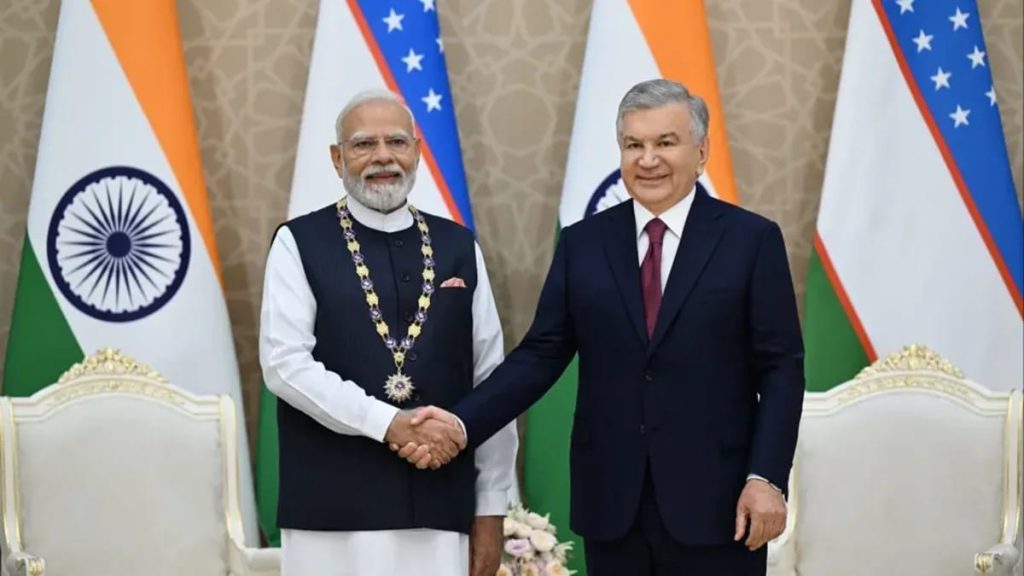
Uzbekistan, India to elevate bilateral
relations to comprehensive strategic partnership.
International News Desk
According to Global Times News Agency Europe,Uzbekistan and India have agreed to elevate their bilateral relations to a comprehensive strategic partnership, specifically targeting an increase in mutual trade to $5 billion by 2030, The global times Europe media informs, citing the Press Service of the President of the Republic of Uzbekistan.The agreements were reached during a meeting between Uzbek President Shavkat Mirziyoyev and Indian Prime Minister Narendra Modi on August 30 at the Kuksaroy Presidential Palace in Tashkent.The leaders discussed further deepening the Uzbek-Indian strategic partnership and expanding multi-faceted cooperation, noting active engagement at various levels.By the end of 2025, bilateral trade turnover surpassed $1 billion for the first time, and the number of joint ventures has multiplied sevenfold in recent years. There are currently 14 direct weekly flights between Uzbekistan and India.Following the talks, the parties agreed to intensify political ties and exchanges at all levels, particularly through parliamentary friendship groups, the Intergovernmental Commission, and the Business Council. A special coordination mechanism at the level of foreign ministry heads is also planned.The leaders discussed expanding industrial cooperation and implementing new joint projects in promising sectors, including energy, electrical engineering, metallurgy, critical minerals, healthcare, pharmaceuticals, agriculture, and jewelry.Mirziyoyev and Modi exchanged views on regional and international issues, highlighting effective cooperation within the UN, SCO, BRICS, and other international formats.At the conclusion of the talks, instructions were given to intensify work on joint projects and programs, with specific roadmaps outlining implementation mechanisms, responsible parties, and deadlines for each priority area. Several bilateral documents covering trade, investment, culture, humanitarian affairs, tourism, and education were signed following the meeting.