
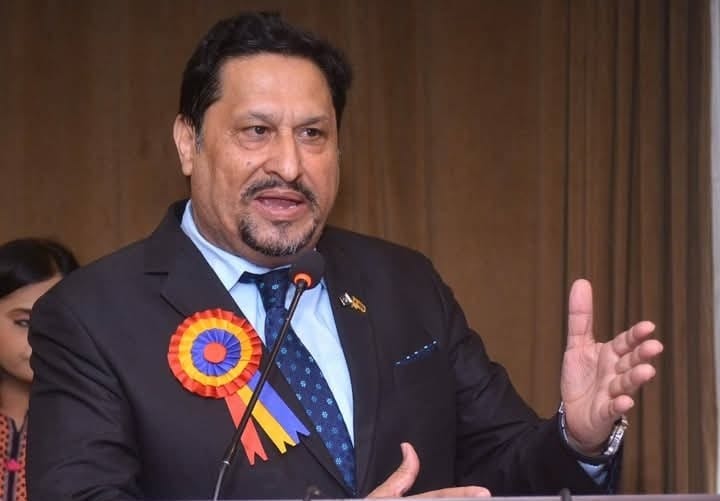
The Blue Economy: Unlocking Opportunities for Pakistan and Sri Lanka.Yasin Joyia, Honorary Consul General of Sri Lanka in Punjab, Pakistan
Lahore(Report by Nadia Tabasum) According to global times News Agency Europe,The oceans are no longer seen as vast expanses of water that simply separate nations; they have evolved into dynamic bridges of opportunity. Today, they drive global trade, innovation, and resilience, creating unprecedented potential for nations that recognize their true value. This transformative vision, known as the Blue Economy, provides a roadmap for harmonizing economic growth with environmental preservation. For Pakistan and Sri Lanka, two nations strategically located along the bustling maritime arteries of the Indian Ocean, the promise of the Blue Economy has never been more relevant. At its core, the Blue Economy is about sustainably unlocking the wealth of our oceans, generating long-term economic value while protecting marine ecosystems for future generations. It represents a paradigm shift from short-term, extractive exploitation to inclusive, sustainable growth that benefits people, economies, and nature alike. This vision encompasses a wide range of maritime sectors, including sustainable fisheries and aquaculture, modern maritime logistics, and the development of smart ports that enhance trade efficiency. It also extends to renewable ocean energy such as tidal, wind, and wave power, which can diversify national energy portfolios. In addition, marine biotechnology holds the promise of groundbreaking innovations in healthcare, agriculture, and industry, while eco-tourism continues to build meaningful connections between travelers and pristine natural spaces. Emerging digital technologies, like AI-driven analytics and satellite mapping, are also transforming marine governance and resource management, enabling nations to manage ocean resources more intelligently and efficiently.
Pakistan, with its 1,050-kilometer coastline and an Exclusive Economic Zone spanning approximately 290,000 square kilometers, holds immense but largely untapped potential. The ports of Gwadar, Karachi, and Port Qasim are not just gateways for trade; they have the potential to evolve into hubs of regional integration, smart logistics, and technological innovation. Strategic investments in aquaculture could position Pakistan as a global supplier of sustainable seafood, creating jobs and strengthening the economy. Furthermore, modernizing port infrastructure and implementing intelligent logistics systems would enhance the country’s role as a transshipment hub connecting the Middle East, Central Asia, and Africa. Offshore wind and tidal energy projects could also play a transformative role by bolstering energy security and reducing dependence on imported fossil fuels.
Sri Lanka, strategically located at the crossroads of vital global shipping lanes, has already established itself as a maritime powerhouse. With an Exclusive Economic Zone exceeding 500,000 square kilometers and a coastline stretching more than 1,600 kilometers, the island nation is uniquely positioned to harness the vast potential of the Blue Economy. Its expertise in shipping and logistics, combined with significant advancements in aquaculture, renewable ocean energy, and marine research, underscores its role as a regional leader. Moreover, Sri Lanka’s thriving eco-tourism industry, from whale watching in Mirissa to coral reef diving, exemplifies its ability to strike a balance between economic growth and ecological preservation.
One of the most compelling aspects of the Blue Economy is its ability to foster collaboration. Pakistan and Sri Lanka, sharing the expansive waters of the Indian Ocean, have a unique opportunity to combine resources, exchange expertise, and develop a cooperative maritime framework that drives innovation and sustainability across the region. As I often emphasize, “Our oceans are not just a source of livelihood; they are a shared heritage and a shared responsibility. By investing in the Blue Economy, we are not only strengthening our economies but also safeguarding the future of our people and our planet.”
A well-structured Blue Economy strategy promises transformative benefits for both nations. It can create widespread economic empowerment through the generation of jobs in fisheries, shipping, marine technology, and tourism, while simultaneously fostering environmental resilience by protecting biodiversity and restoring marine ecosystems. Such an approach would also integrate Pakistan and Sri Lanka more deeply into global trade networks and open avenues for blue financing opportunities. Most importantly, it can uplift coastal communities by providing education, skill development, and sustainable livelihoods, ensuring that the benefits of ocean-driven growth are widely shared.
The Blue Economy is not merely an economic model; it is a vision for shared prosperity that demands innovation, partnership, and an unwavering c