
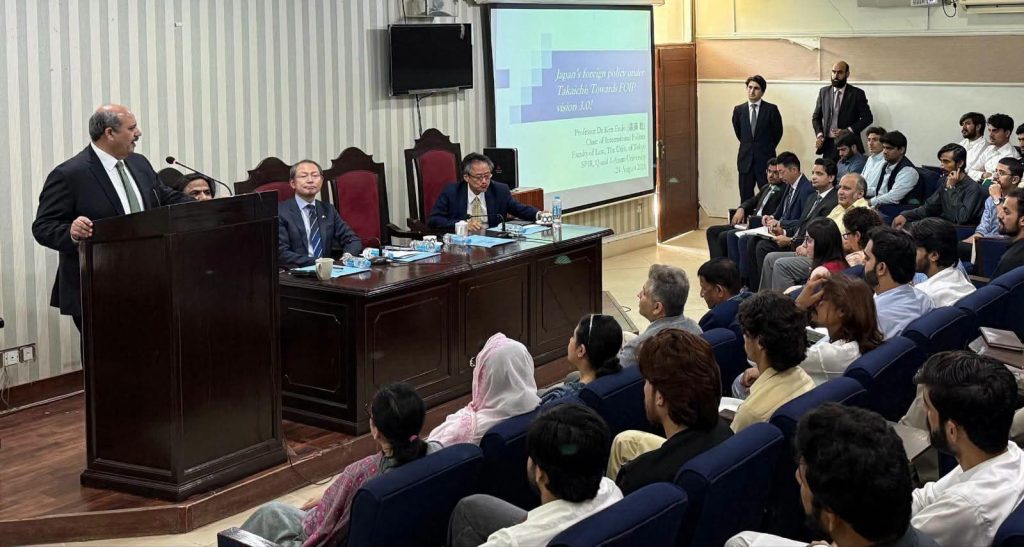
QAU Hosts Seminar on Japan’s FOIP
3.0 and Future of Middle-Power Diplomacy
ISLAMABAD:(Special Representative)According to Global times News Agancy Europe,The School of Politics and International Relations (SPIR), Quaid-i-Azam University (QAU) hosted a seminar titled “Japan’s FOIP 3.0 and the Future of Middle-Power Diplomacy in the Indo-Pacific”, bringing together Japanese diplomats, scholars, faculty members, and students for an in-depth discussion on Japan’s evolving foreign policy and its implications for the Indo-Pacific and Pakistan.Prof. Dr. Zafar Nawaz Jaspal, Vice Chancellor, Quaid-i-Azam University and Meritorious Professor of International Relations, subsequently discussed Japan’s transformation from its post-war pacifist orientation toward a more proactive foreign and security policy. He raised questions concerning the evolution of the Indo-Pacific concept, the QUAD, Japan’s changing defence posture, and its emerging role as a middle power, while also highlighting Pakistan’s perspective on regional developments.The inaugural address was delivered by H.E. Mr. Takamatsu Shuichi, Ambassador of Japan to Pakistan, who emphasized the longstanding friendship between Japan and Pakistan and Japan’s contribution to Pakistan’s development through cooperation in education, health, infrastructure, human-resource development, and other sectors. He also highlighted the strong academic and people-to-people links between Japan and QAU.The main lecture was delivered by Professor Ken Endo, Chair and Professor of International Politics at The University of Tokyo. He traced the evolution of Japan’s foreign policy from its post-war foundations of Article 9 and the US–Japan alliance to the development of the Free and Open Indo-Pacific (FOIP) vision. He explained how FOIP has evolved from a relatively security-focused framework into a broader and more inclusive vision.Discussing FOIP 3.0 under Prime Minister Sanae Takaichi, Professor Endo highlighted emerging priorities including economic security, resilient supply chains, critical minerals, energy security, artificial intelligence, digital connectivity, and security cooperation. He also examined the challenges posed by US–China strategic competition, Japan–China relations, and the changing international order. Particular attention was given to potential areas of Japan–Pakistan cooperation, including economic diversification, critical minerals, resilience, and academic exchange.Earlier the event opened with welcome remarks by Dr. Muhammad Nadeem Mirza, Director SPIR, who highlighted Japan’s significance as an important global power and recalled the longstanding academic cooperation between QAU and Japanese institutions. He emphasized the importance of strengthening academic exchanges and developing greater understanding of Japan’s domestic and foreign policy.In the concluding remarks, Dr. Muhammad Shuaib, Assistant Professor, SPIR, emphasized Japan’s strong reputation for quality, knowledge and technological excellence in Pakistan and called for expanded cooperation in education, technology, and institutional development.