
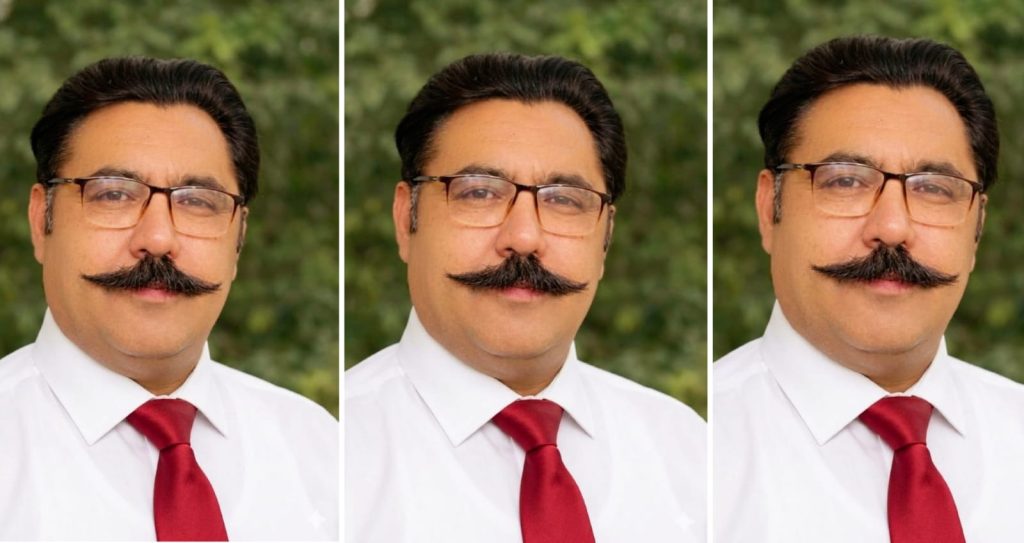
Degree is the guarantee of the
consciousness of nations and their future. Jamshid Khan
Recruitment to vacant posts in universities and colleges should be done immediately and on the basis of 100 percent merit, which is transparent. Chairman College Teachers Movement Khyber Pakhtunkhwa
Peshawar:(Special Representative)According to Global times News Agancy Europe,Tears of Hope and Unfulfilled Desires: The Meltdown of Our Education System and the Fractured Future of Our Youth These words, written with the heart’s blood, are not merely disjointed or random sentences scattered across a Facebook page; they are a mournful lament pouring from the pen of a grief-stricken professor charged with the sacred duty of nation-building. As an architect of the nation, whenever I witness the educational, political, moral, societal, and intellectual decay sprawling around me, my pen simply refuses to remain silent. Education is not merely the title of a degree placed upon the head of an innocent student by a Chief Minister or Governor during a convocation ceremony. A degree is the solemn guarantee of a nation’s collective consciousness and its destiny. Yet, when the State and its policy-makers relegate education to their lowest priority, the consequences are bound to be as catastrophic as those we have recently witnessed.The elites and policy-makers of our country remain hopelessly detached, prioritizing their own luxuries, whims, and comforts far above the plight of the common people. Their investments, assets, and sanctuaries are safely established in Europe and America, while the hardworking, impoverished youth of this God-given land—particularly in Khyber Pakhtunkhwa—yearn in vain for basic educational and economic rights. It appears as though our ruling authority harbors a deep, intrinsic hostility toward education. Health and education, which ought to be the foundational responsibilities of any civilized state, appear to have been completely expunged from the government’s priorities.
A news report published in the daily Aaj paints a chilling, vivid, and agonizing picture of this dire reality. In Khyber Pakhtunkhwa, 43,989 young applicants vied for merely 55 positions in the Provincial Management Service (PMS). Following the initial screening test, 9,896 candidates were shortlisted for the written examination, yet only 5,071 actually appeared. These figures starkly highlight the monstrous specter of educated unemployment looming over our province. But hold your breath—the tragedy does not end here. Out of the 5,071 candidates who took the written examination, the declared results revealed that after fierce competition, a paltry 50 candidates managed to pass! That represents a success rate of barely one percent.The paramount question arises: Why did such a overwhelming majority of our youth fail? Above all, why has English been elevated as the sole benchmark of intellect, merit, and competence? Must a young person’s administrative acumen, intellect, and critical thought be held entirely hostage to a foreign tongue?The tragic flaw of our educational and bureaucratic apparatus is that it measures capability not by practical efficacy, but by rote learning. If a candidate writes "Mangoes are eaten by me” as the passive voice for "I am eating mangoes” in an English exam, they are summarily failed for omitting the word "being”—even if that very individual, through their practical expertise and tireless labor, generates three billion rupees in foreign exchange for the country through their mango orchards. This system scrutinizes grammatical mechanics on paper while completely ignoring the tangible economic value created for the nation.
To be clear, no one can deny the universally recognized significance and utility of the English language on the global stage. It is indeed an urgent requirement of our times that English be taught as a compulsory subject at the Bachelor of Science (BS) level across all disciplines in religious seminaries, colleges, and universities, enabling students to engage with global networks and modern sciences. However, reducing an individual’s overall capability, wisdom, and administrative intellect solely to their proficiency in English is an overt injustice. Language is merely a medium for the communication of information; it is no substitute for intellect and insight. Therefore, competitive examinations must prioritize critical thinking and subject-matter expertise over mere mastery of a foreign language.Furthermore, a grave question mark hangs over the transparency of this examination system. A very close relative of mine—who holds an M.Phil in English and possesses proven scholarly and literary talent, belonging to a family teeming with doctors, engineers, PES and CSS officers, and university professors—was awarded a mere 16 marks in the "English Precis” paper. This defies all logic and reason. When an M.Phil degree holder scores 16 marks, it demands a thorough inquiry into whether the examiners truly evaluated the papers with fairness, consistency, and transparency, or if the marking was subject to arbitrary, uncalled-for severity. As a professor, I demand that the Chairman of the Khyber Pakhtunkhwa Public Service Commission initiate a high-level investigation into this unjust evaluation.
Can the government absolve itself of all responsibility by laying the entire blame for this abysmal performance solely at the doorstep of universities and educational institutions? Absolutely not. The truth is that both our federal and provincial governments have failed miserably to provide universities and colleges with basic infrastructure, modern laboratories, updated libraries, and research grants.In nearly 300 government colleges across Khyber Pakhtunkhwa, roughly 3,500 teaching posts lie vacant, with no serious effort being made to fill them. The financial and administrative plight of our universities is even more deplorable. When classrooms lack teachers, laboratories lack equipment, and libraries lack modern books, what results can we possibly expect from our students? This is precisely why enrollment rates in our educational institutions are plummeting to dangerous lows, and the youth are losing all faith in the value of academic degrees.Regrettably, another side of this picture points directly toward our youth themselves. While the indifference of the State is undeniable, a vast majority of our young people are also guilty of evading their responsibilities. Out of nearly 50,000 applicants, only 5,000 appeared for the exam while the rest abandoned the field—a clear testament to a lack of diligence and serious preparation. The misuse of the internet and smartphones has severely damaged the intellectual sharpness and reading habits of our youth. Indulgence in frivolity, fleeting entertainment, and squandering time has rusted their inherent talents.If we are to save this nation and its upcoming generation from total collapse, we must implement immediate and decisive remedies for these ailments:
Immediate Recruitment: All 3,500 vacant positions in colleges and universities must be filled immediately through a transparent process based 100% on pure merit.Resource Provision: Educational institutions must be equipped with state-of-the-art laboratories, modern libraries, and substantial research grants.Career Counseling: Formal career guidance programs based on psychological aptitudes must be instituted across all educational centers to steer the youth in the right direction, transforming the internet from a time-sink into a tool for acquiring knowledge.Depoliticization: All educational institutions must be purged of political interference to establish the absolute reign of merit and competence.Evaluation Reform: The Public Service Commission’s paper evaluation system must be made transparent, logical, and balanced to prevent any deserving candidate from being wronged.Our youth are our most precious asset. If their potential is left uncultivated and the systemic flaws in our educational and examination systems continue to be swept under the rug, the abyss of economic and intellectual decay will only deepen. There is still time for reform; otherwise, history will forgive no one.An Impassioned Appeal to the Honorable Chief Minister of Khyber Pakhtunkhwa, Mr. Ali Amin Gandapur, and the Honorable Minister for Higher Education, Mr. Meena Khan Afridi
Respected Sirs,
You both represent a youthful, dynamic, and capable leadership—the ultimate beacon of hope for the youth of this province. The firm promises you made to the architects of this nation regarding quality education, honorable employment, and a life of dignity must now transcend paper declarations and materialize into tangible reality.The educational institutions of this province are currently bogged down in a quagmire of administrative, foundational, and instructional crises that demand your immediate, direct, and personal intervention.Do not allow the flickering flame of hope among our youth to be extinguished, nor leave their passion to be consumed by despair. Honor your pledges by reforming the dire conditions of our institutions, so that the bright future of Khyber Pakhtunkhwa remembers your landmark actions in the golden pages of history.